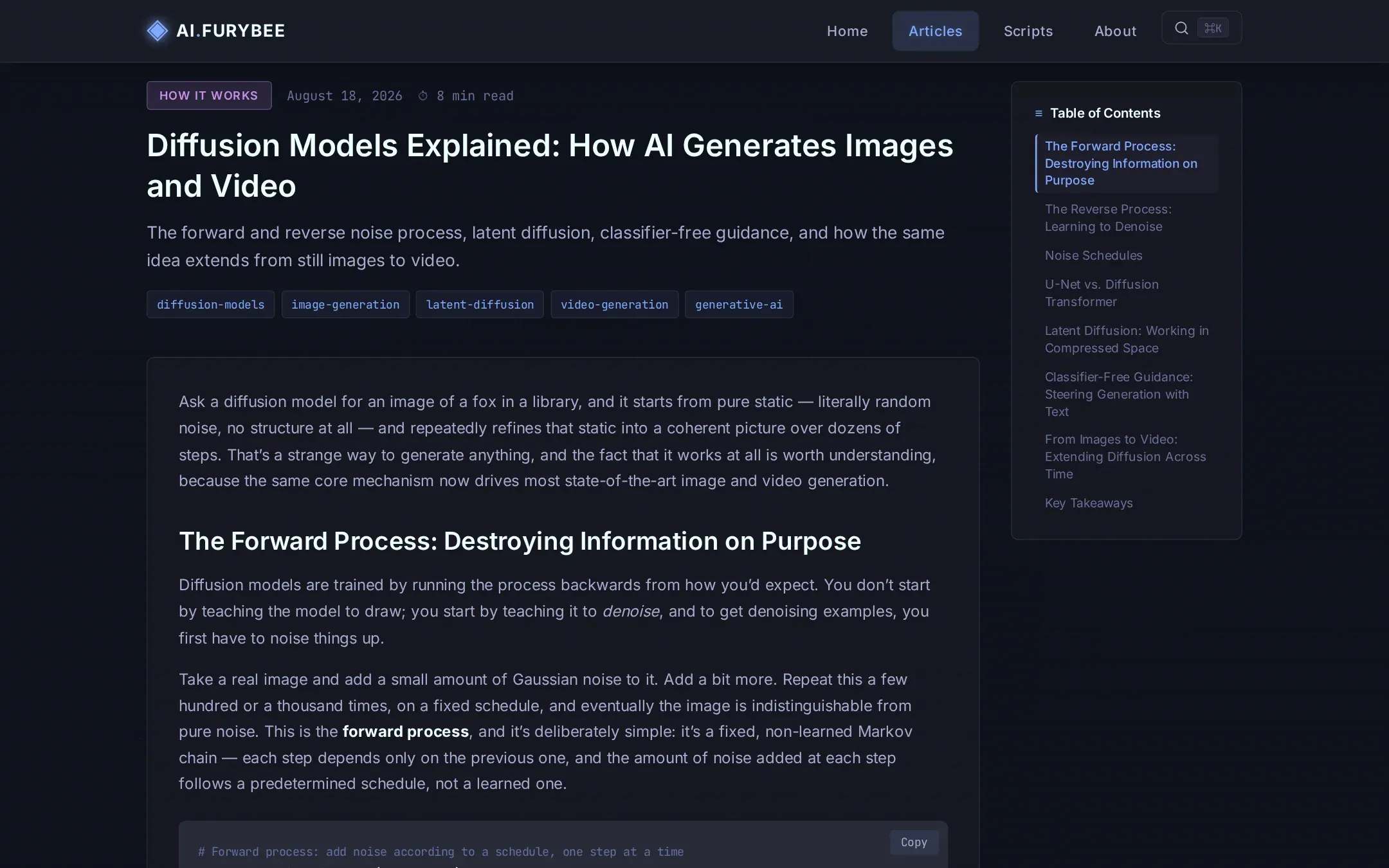
Serving LLMs in Production: PagedAttention, Continuous Batching and vLLM
How modern LLM servers keep GPUs busy: continuous batching, PagedAttention for KV cache memory, prefix caching and vLLM in practice, with launch commands and tuning advice.
Article library
How AI works, from fundamentals and transformer internals to hardware, benchmarks and practical tooling.

AI.FuryBee is an English article library about artificial intelligence. Articles are grouped into eight categories: How It Works, Practical AI, Hardware, Training & Data, Models & Players, Benchmarks, Fundamentals, and Ethics & Safety.
Topics go from first principles to the details that matter in production: the KV cache, speculative decoding, LoRA and QLoRA, RLHF, mixture of experts, accelerator hardware, leaderboards such as Chatbot Arena, prompt caching, and the energy and water footprint of training and inference.
From Fundamentals for newcomers to Hardware and Benchmarks for people comparing models and accelerators.
Embedding similarity, an LLM API playground, a LoRA fine-tuning starter, an Ollama quickstart, prompt templates, a RAG starter kit and a token counter.
Pagefind indexes the site at build time, so search runs locally without a search server.
Each article has a table of contents, a reading-time estimate and links to the previous and next article.
Follow new articles at ai.furybee.org/rss.xml.
The site is generated ahead of time with Astro and served as static files by Nginx. Code samples are highlighted at build time. The FuryBee portal reads its RSS feed to list the latest articles on the Articles page.
How modern LLM servers keep GPUs busy: continuous batching, PagedAttention for KV cache memory, prefix caching and vLLM in practice, with launch commands and tuning advice.
What mechanistic interpretability tries to do, from features and superposition to circuits and sparse autoencoders, and what it can and cannot tell us about AI safety today.
Why vector search alone misses answers, how BM25 plus dense retrieval plus a cross-encoder reranker fixes it, and how to build and evaluate the pipeline with working code.
How state space models and Mamba process sequences with a fixed-size memory instead of attention, what they gain in long-context efficiency, and where transformers still win.
No. The Fundamentals category starts from the basics, and articles explain terms as they introduce them. Deeper categories such as How It Works and Hardware are there when you want more.
The library had 77 articles across 8 categories in October 2026, plus 7 starter scripts. The Articles page on furybee.org shows the newest ones.
Yes, through the RSS feed at https://ai.furybee.org/rss.xml.
No. Search runs in your browser with Pagefind, and the site uses no analytics.

AI.FuryBee lives at ai.furybee.org
Open AI.FuryBee